Workplace Air Quality Monitoring: A COSHH & HSE Compliance Guide
25th September 2026•By Neil Skoglund
Compliance Guide
Workplace air quality is easy to overlook because it's invisible - a poorly ventilated meeting room doesn't look any different from a well-ventilated one. But CO2 build-up, VOCs and particulates directly affect concentration, wellbeing, and in regulated environments, compliance with UK health and safety law.
This guide focuses on workplace air quality specifically - offices, schools, warehouses and commercial buildings - and what UK employers should know about monitoring it. For air quality in healthcare and general indoor settings, see our ultimate guide to indoor air quality monitoring.
Why Workplace Air Quality Is a Compliance Issue, Not Just Comfort
The Health and Safety at Work etc. Act 1974 and the COSHH Regulations 2002 place a general duty on employers to assess and control risks from substances that could harm health, and the Workplace (Health, Safety and Welfare) Regulations 1992 specifically require “effective and suitable” ventilation. For most offices this is manageable with normal ventilation, but for workplaces with higher occupancy density, chemical processes, or older HVAC systems, it's easy to drift into poor air quality without anyone noticing until productivity or wellbeing complaints show up.
Regulatory exposure
Being unable to demonstrate adequate ventilation is a real gap under COSHH and general health and safety duties.
Staff wellbeing
Elevated CO2 is linked to fatigue and reduced concentration - directly affecting the people working in the space.
Building performance
Continuous data reveals whether HVAC systems are actually doing their job across a building's different zones.
High-occupancy spaces
Classrooms, meeting rooms and open-plan offices see CO2 spike fastest and benefit most from continuous monitoring.
What to Monitor, and What Trackpac's Sensors Measure
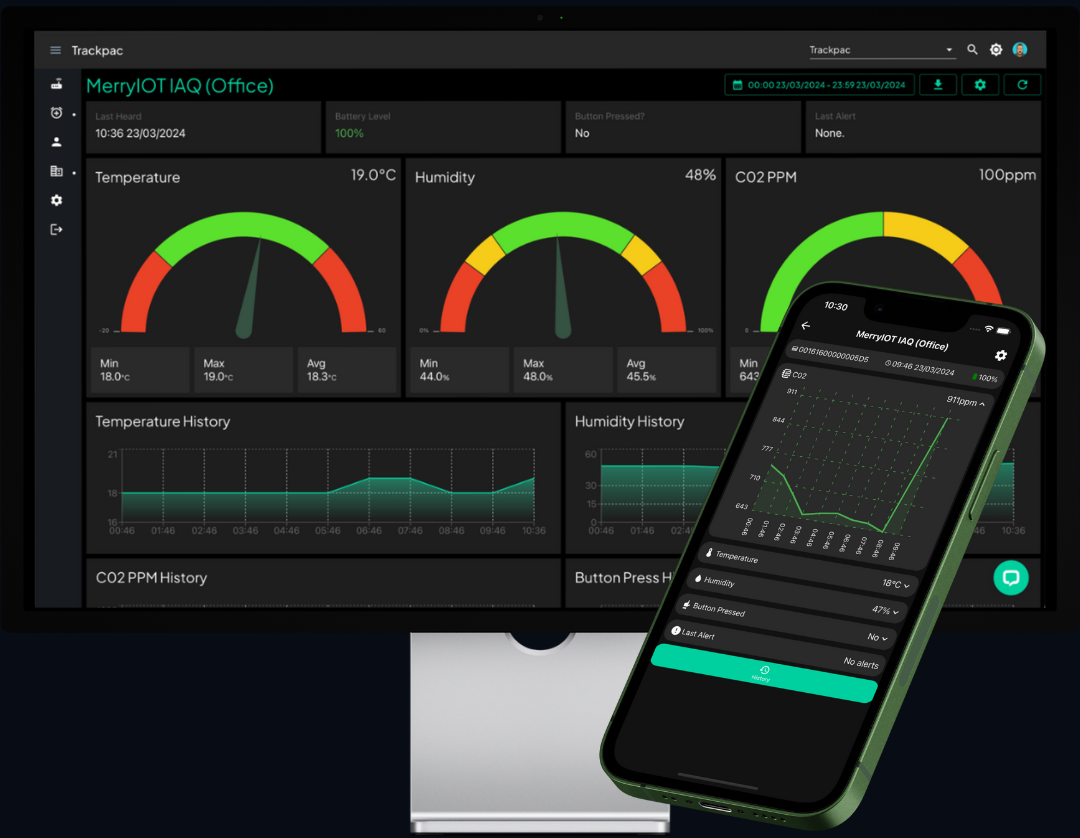
A single compact sensor can cover the metrics that matter for workplace air quality:
CO2 - the primary indicator of ventilation adequacy in occupied spaces
TVOCs - total volatile organic compounds from cleaning products, furnishings, and materials
Particulate matter (PM2.5 & PM10) - fine particles from dust, traffic infiltration, or nearby activity
Temperature & humidity - both a comfort factor and a driver of mould/condensation risk
From data to action
Continuous monitoring only helps if it triggers a response. Trackpac's rules engine can alert facilities teams when CO2 or VOC levels cross a threshold, so ventilation can be adjusted before staff notice a stuffy room - and the timestamped history gives you evidence of ventilation performance over time, not just a snapshot.
Many sites deploy the same air quality sensor across multiple rooms or floors to compare zones - useful for identifying which parts of a building have a genuine ventilation problem versus which are performing fine.
Frequently Asked Questions
Is workplace air quality monitoring a legal requirement in the UK?↓
Under the Control of Substances Hazardous to Health (COSHH) Regulations 2002 and the Health and Safety at Work etc. Act 1974, employers have a general duty to assess and control risks from hazardous substances and maintain adequate ventilation. There isn't a single blanket requirement to install continuous CO2 or VOC sensors everywhere, but for workplaces with specific air quality risks - poor ventilation, chemical exposure, high occupancy - continuous monitoring is a practical way to demonstrate that duty is being met.
What should workplace CO2 levels be?↓
The HSE's Workplace (Health, Safety and Welfare) Regulations 1992 guidance suggests CO2 concentrations above roughly 1,000ppm indicate poor ventilation, though there's no single fixed legal limit for general workplaces (as opposed to specific COSHH workplace exposure limits for other substances). Many building standards and ventilation guidance treat 1,000ppm as a practical threshold for taking action, with levels above 1,500ppm generally considered a sign that ventilation needs improving.
What does a workplace air quality sensor actually measure?↓
Trackpac's supported air quality sensors measure CO2, temperature, humidity, TVOCs (total volatile organic compounds) and particulate matter (PM2.5 and PM10) from a single compact device, giving a rounded picture of ventilation and air quality rather than just one metric.