SenseCAP T2000 vs T1000: Which Tracker Do You Need?
26th October 2026•By Neil Skoglund
T2000 Guide
The SenseCAP T1000 and T2000 come from the same Seeed family. Both are LoRaWAN trackers, both use satellites and Bluetooth to find themselves, both are set up with the same SenseCraft app and both work with Trackpac. Beyond that, they are built for very different jobs.
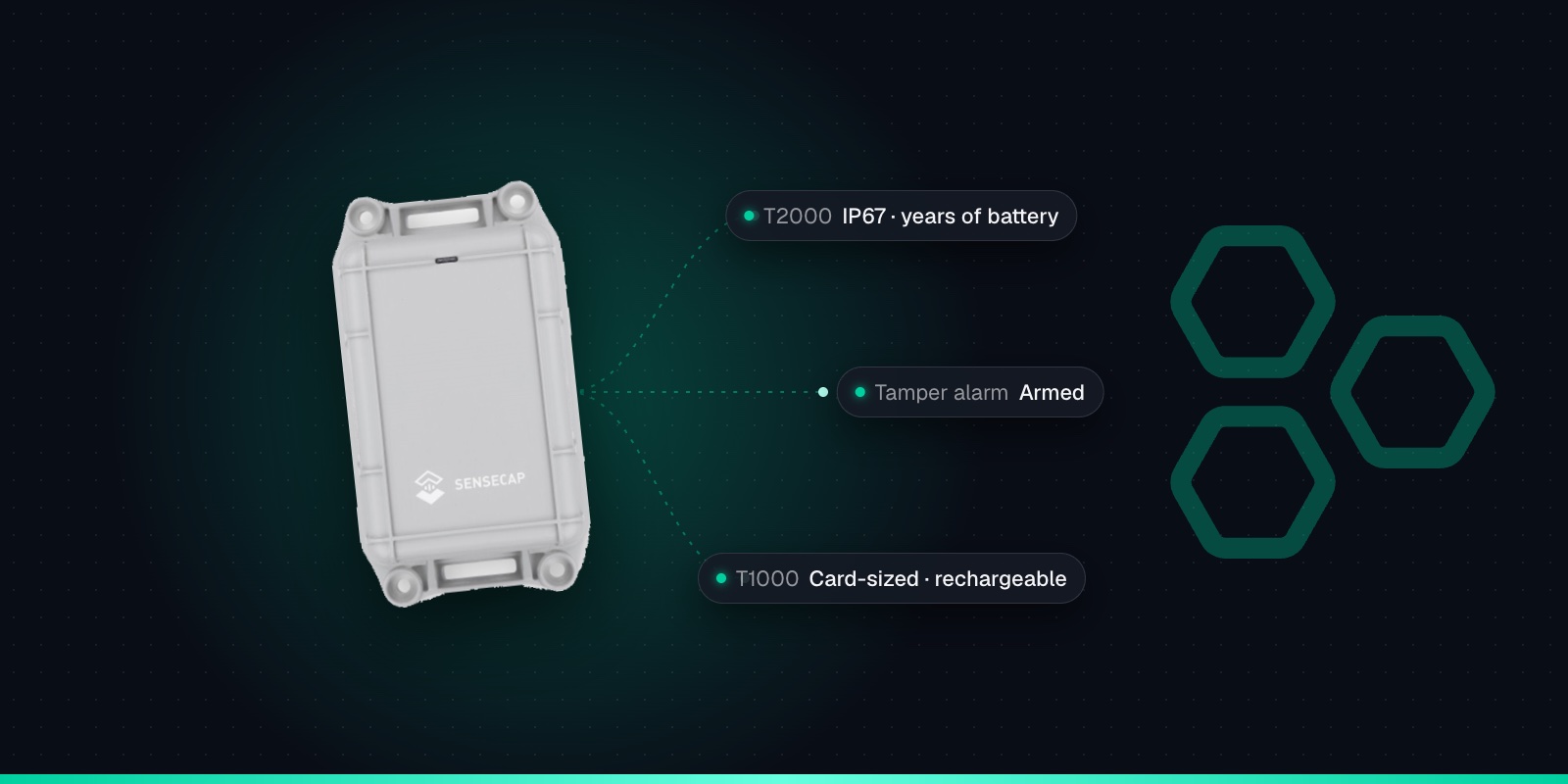
The T1000 is a slim, rechargeable card for people, bags and small kit. The T2000 is a rugged box with a tamper alarm that you screw or strap to something and leave for years. This guide compares them side by side and shows which one suits which job. For full specifications, see our SenseCAP T2000 page and SenseCAP T1000 page.
The Short Answer
Choose the T1000 for anything a person carries or that needs to stay small: lone workers, bags, parcels, flight cases and small tools. It has an SOS button and recharges in about 2 hours, but needs charging every few months.
Choose the T2000 for things that live outdoors and that you fix the tracker to: plant, trailers, shipping containers and livestock. It is tougher, has a tamper alarm, and runs for over a year to several years without charging.
Running both is fine. Trackpac shows T1000s and T2000s on the same map, with the same geofences and alert rules.
SenseCAP T2000 vs T1000 Side by Side
All figures come from Seeed's own documentation. The T1000 column covers the T1000-A and T1000-B, the two LoRaWAN versions Trackpac supports. The T2000 comes in three versions: A, B and C.
700mAh rechargeable battery, magnetic 2-pin charging cable
Battery life (Seeed)
A/B: over 1 year at hourly GPS, up to 7 to 9 years at longer intervals. C: multi-year in regular sunlight
About 3.5 months at hourly GPS (106 days on EU868); headline 4 months
Rechargeable
A/B: no. C: yes, from its solar panel
Yes, about 2 hours for a full charge
IP rating
IP67
IP65
Operating temperature
A/B: -40 to +85°C. C: -20 to +60°C
-20 to +60°C
Positioning
GPS, GLONASS, BeiDou and QZSS plus Bluetooth beacons; Wi-Fi on the T2000-B only
GPS, GLONASS, Galileo, BeiDou and QZSS plus Wi-Fi and Bluetooth beacons
Sensors
3-axis accelerometer on all three
A: accelerometer, temperature, light. B: none
Tamper alarm
Yes, button on the back
No
SOS button
No
Yes (double press)
Controls
No button; tap a magnet on the case
One button, LED and buzzer
Mounting
Screws, strap or 3M double-sided tape
Card-sized, goes in a pocket, bag or case
Offline cache
Up to 1,000 records (off by default)
1,000 records
ATEX
T2000-A and T2000-B certified; the C is not
Not listed in Seeed's certifications
Trackpac alerts
Tamper, start moving, end movement, motionless, shock, battery %, geofences
SOS, button press, start moving, end movement, motionless, shock, temperature & light (A), battery %, geofences
Size, Mounting and Toughness
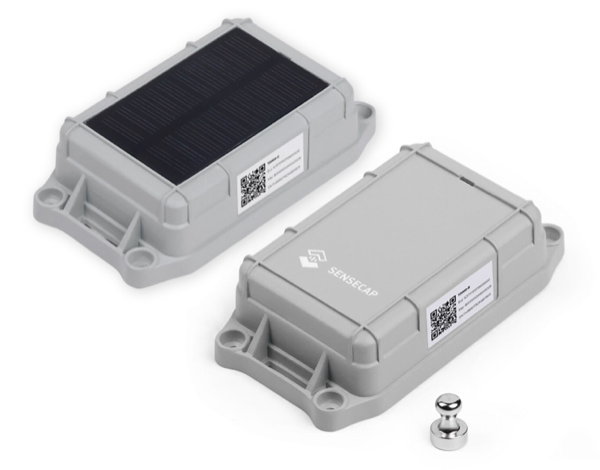
The most obvious difference is size. The T1000 is the size of a bank card and weighs 32g, so it disappears into a wallet, a bag lining or a tool case. The T2000 is 117 × 65 × 30mm and 180g, in a glass-fibre reinforced case. It is not something you hide in a pocket. It is something you screw to a container door frame, bolt inside a machine's bodywork or strap to a cow.
That shows in the ratings. The T2000 is IP67, dust-tight and protected against temporary immersion, where the T1000 is IP65 and should be mounted somewhere sheltered on kit that gets pressure washed. The T2000-A and T2000-B are rated from -40 to +85°C, against -20 to +60°C for the T1000. The solar T2000-C shares the T1000's -20 to +60°C range.
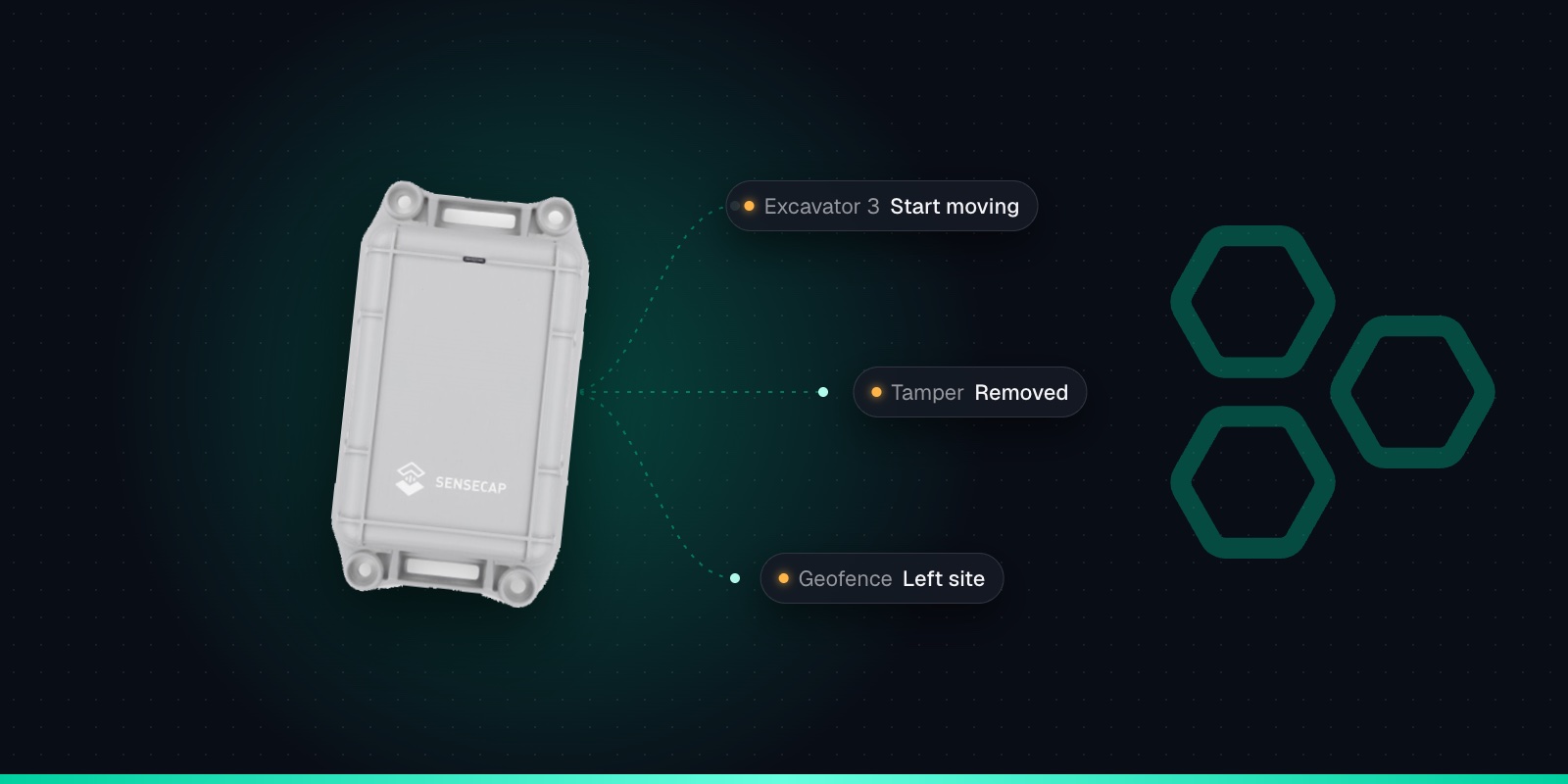
The T2000 also has a feature the T1000 lacks entirely: a tamper button on the back. Mount it so the button is held in, and the moment someone removes the tracker it raises what Seeed calls a top-priority alarm, sending its position every minute for 3 minutes by default. A thief who knows it is there can still take it off, but the removal itself is what triggers the alert. The T2000-A and T2000-B are also ATEX certified, which matters if your kit works in potentially explosive atmospheres. Seeed doesn't publish the zone or marking on its wiki, so check the certificate against your own zone and safety rules before relying on it.
Power: Charge Every Few Months, or Fit and Forget
This is where the two trackers really part ways. The T1000 has a 700mAh rechargeable battery. Seeed's FAQ gives about 3.5 months with a GPS fix every hour (106 days on EU868), and its headline figure is 4 months. Then it goes back on its magnetic cable for about 2 hours. That suits kit that comes back to base, and it suits people, who can charge it with their phone.
The T2000-A and T2000-B have an 8000mAh primary lithium cell. Seeed quotes over one year with hourly GPS updates, and up to 7 to 9 years with longer intervals. The cell is not rechargeable, so there is no charging routine at all: you fit the tracker and leave it. The T2000-C swaps that for a 4000mAh rechargeable battery and a 0.5W solar panel, which Seeed says gives multi-year, low-maintenance running under regular sunlight and moderate intervals.
Outdoors, both use satellite positioning and both default to GPS only. Seeed claims 5 to 10m accuracy for the T2000 outdoors. Neither gets a GPS fix indoors or inside a steel container, because satellite signals need a view of the sky.
Indoors, Wi-Fi is the usual answer: the tracker scans nearby access points and the platform looks them up. Both the T1000-A and T1000-B can do this. On the T2000, only the T2000-B has Wi-Fi; the A and C rely on GPS and Bluetooth. Trackpac's location engine resolves Wi-Fi scans into a position automatically. Bluetooth positioning works on all of them, but needs beacons installed at known positions, which is something to plan with us.
On sensors, every T2000 has a 3-axis accelerometer, which drives the start moving, end movement, motionless and shock events. It is off by default ("Enable 3-axis sensor" in the app) because it uses more power, so switch it on if you want movement-triggered alerts. The T1000-A has an accelerometer plus temperature and light sensors; the T1000-B has none of the three. The T2000 has no temperature or light sensor, so if you want an indication of temperature in transit, the T1000-A is the one of these two that does it.
Buttons, Magnets and Alerts
The T1000 has a single button with a buzzer. Hold it to switch on or off, press once to send a location, and double press for SOS, which by default keeps reporting every minute until it has sent 30 times. That makes it a reasonable lone-worker device.
The T2000 has no button you can press. You tap the supplied magnet on the sensor area: 4 quick taps to switch it on or off, 2 to turn Bluetooth on for the app. That suits the job: on a machine or a container there is nothing for a passer-by to switch off, and no SOS to set off by accident. It also means the T2000 is the wrong choice if a person needs to raise an alarm.
In Trackpac, a T2000 can alert on tamper (shown as "Disassembled"), start moving, end movement, motionless, shock and battery level, plus location through geofences. A T1000 adds SOS and button-press alerts, and temperature and light on the A. Alerts go by email, SMS or push notification to the contacts you choose.
Which One for Which Job
A simple test: if a person carries it or it has to be small, choose the T1000. If you fix it to something that lives outdoors and you don't want to think about charging, choose the T2000.
People & lone working: T1000
It fits in a pocket or a bag, and the SOS button lets someone ask for help. The T2000 has no button a person can press.
Bags, parcels & small kit: T1000
At 32g and 6.5mm thick it slips into a laptop bag, flight case, parcel or tool box where a 180g box would be obvious or wouldn't fit.
Plant & machinery: T2000
Screw it to an excavator, generator or tower light, leave it for years, and get an alert if it moves out of hours or someone pulls it off.
Trailers & containers: T2000
IP67, -40 to +85°C on the A/B, screw mounting and the offline cache suit assets that spend months outdoors and on the road.
Livestock: T2000
At 180g with a strap, it is suited to large animals such as cattle and horses, the ones Seeed lists. Fit the strap so it doesn't rub or snag, and follow your own animal welfare practice.
Indoor stock & returnables: either
Indoors, use Wi-Fi positioning: both T1000s have it, and of the T2000s only the B does. The T1000 is easier to recharge between trips.
Plenty of operations need both. A plant hire firm might bolt T2000s to its excavators and generators and put T1000s in the tool cases that travel with them. A farm might strap T2000s to cattle and give a T1000 to whoever checks the fields alone.
Trackpac handles both on the same map. You add each one the same way: set "Other Platform" in the SenseCraft app, copy the keys, and add the tracker in Trackpac with the matching device type (SenseCAP T1000 or SenseCAP T2000). The Trackpac network roams onto Helium and other public LoRaWAN networks, so where there is coverage you don't need your own gateway. For remote sites, our LoRaWAN consultancy can help you add one.
Once they are in, use tags to group trackers by site, customer or type, and point alert rules at a tag so every tracker with it shares the rule. Geofences work the same for both. Trackpac costs £15 / €18 per tracker per year, whichever model it is, covering connectivity, the dashboard, alerts and data storage. You can create an account and add your first tracker in a few minutes.
Where to Buy
The T2000 is sold direct by Seeed Studio as the T2000-A, T2000-B and T2000-C. In the UK, The Pi Hut stocks the T2000-A at £48 including VAT at the time of writing (October 2026), with UK delivery only because of the lithium battery.
The T1000-A and T1000-B cost less per unit, and our T1000 page has the buying links. Either way, check LoRaWAN coverage where the trackers will work before you buy in quantity. Neither has a SIM, so both need a gateway in range; our guide to checking LoRaWAN coverage in the UK explains how.
Get Started
T1000, T2000 or both: one dashboard
Add your SenseCAP trackers to Trackpac for live location, geofences and tamper, movement and battery alerts, with no gateway or network server to run.
Works with the T2000-A, T2000-B and T2000-C. Add one with its keys in a couple of minutes.
Connectivity through the Trackpac network, which roams onto Helium, so there's no network server to run.
Dashboard, alerts and data storage from £15 / €18 per tracker per year.
What is the difference between the SenseCAP T1000 and T2000?↓
Both are Seeed SenseCAP LoRaWAN trackers, built for different jobs. The T1000 is a 32g, credit-card sized tracker with a 700mAh rechargeable battery, an SOS button and an IP65 case, made for people, bags and small kit. The T2000 is a 180g box (117 × 65 × 30mm) with an IP67 case, a tamper alarm that fires when it is removed, and an 8000mAh battery that Seeed says lasts over a year at hourly GPS updates and up to 7 to 9 years at longer intervals. There is also a solar-powered T2000-C. Choose the T1000 for things you carry and the T2000 for things you bolt it to.
Which lasts longer, the SenseCAP T1000 or the T2000?↓
The T2000, by a long way. Seeed quotes over one year for the T2000-A and T2000-B with a GPS fix every hour, and up to 7 to 9 years with longer intervals. For the T1000, Seeed's FAQ gives about 3.5 months at hourly GPS fixes (106 days on EU868), with a headline figure of 4 months, and then you recharge it. The trade-off is that the T2000-A and T2000-B batteries are not rechargeable, while the T1000 recharges in about 2 hours.
Does the SenseCAP T2000 have an SOS button?↓
No. The T2000 has no user button at all. You switch it on and off and turn Bluetooth on by tapping a supplied magnet on the sensor area. Instead of an SOS button it has a tamper button on the back that stays pressed while the tracker is mounted and raises an alarm when it is removed. If you need a button a person can press for help, the T1000 has one: a double press starts an SOS alert.
Is the SenseCAP T2000 more waterproof than the T1000?↓
Yes. The T2000 is rated IP67, which means dust-tight and protected against temporary immersion. The T1000 is rated IP65: dust-tight and protected against water jets, but not rated for immersion. The T2000-A and T2000-B also work from -40 to +85°C, against -20 to +60°C for the T1000 and the solar T2000-C.
Can I track T1000 and T2000 trackers on the same platform?↓
Yes. Trackpac supports the T1000-A, T1000-B and all three T2000 models. Both are added the same way: set Other Platform in the SenseCraft app, copy the keys, and add the tracker in Trackpac with the matching device type. They then sit on the same map, share geofences and alert rules, and can be grouped with tags. Trackpac costs £15 / €18 per tracker per year.